

Vendor Compliance Management Resources

Vendor Compliance Management Resources
Successful vendor compliance management depends on clean data. Problem is—bad vendor data doesn’t announce itself. It shows up as a failed payment, a rejected 1099, an OFAC match that should have been caught at onboarding, or an audit finding that traces back to a vendor record nobody can authenticate. By the time the problem is visible, it’s already expensive.
For AP, treasury, and finance teams, vendor data accuracy and onboarding compliance aren’t back-office housekeeping — they’re operational risk. The vendor master is only as trustworthy as the process that built it, and most processes weren’t built with that in mind.
This page is your starting point for vendor compliance management resources, vendor onboarding compliance software resources, and the frameworks your team needs to get — and stay — clean.
Feeling the dowstream pain
Payments are failing. 1099s are coming back. Someone in finance is manually chasing down TINs before the January deadline, again. You know the vendor master has problems but you’re not sure where to start fixing them. Our vendor compliance management resources help you diagnose what’s broken and build a remediation path.
Audit or deadline driven
A compliance review is coming, a state registration requirement has changed, or your OFAC screening process doesn’t hold up to scrutiny. You need to demonstrate that your vendor compliance management meets a defensible standard — and you need documentation to prove it. Our compliance controls resources walk through what a robust program looks like and where most organizations fall short.
Ensure vendor data accuracy
Vendor master data problems are more common—and more consequential—than most finance teams realize until something breaks.
The root cause of most vendor compliance management problems is almost always the same: vendor data entered the system through a process that prioritized speed over authentication. Banking details were collected by email. TINs were self-reported and never validated. Addresses were copied from invoices. Over time, the vendor master becomes a record of what vendors told you, not an authenticated source of truth.
The risks of inaccurate vendor data compound quickly:
- Payment failures and delays from stale or incorrect banking details
- 1099 penalties from mismatched TINs that fail IRS B-Notice thresholds
- Duplicate vendor records that obscure spend visibility and create opportunities for fraud
- OFAC exposure from vendors that were never screened or screened once and never again
- State compliance gaps from vendors operating under names or addresses that don’t match registration records
Fixing vendor master data problems after the fact is painful and resource-intensive. The more durable solution is building authentication into the front of the process, so data entering your ERP is clean, validated, and audit-ready from day one.
PaymentWorks simplifies vendor compliance management by automating vendor data collection and validation at the point of onboarding and matching submitted information against authoritative sources before it ever touches your vendor master.
Improve sanctions screening controls
Sanctions screening is a major part of vendor compliance management, and the requirements have grown more complex. Sanctions and watchlist data changes constantly, ownership structures shift after onboarding, and screening that happens once at intake doesn’t hold up under continued scrutiny.
Most organizations have some version of a sanctions screening process. The gap is usually in consistency, documentation, and coverage. A manual process that works when one person is managing it tends to break down under volume, staff turnover, or the scrutiny of an actual audit.
Common sanctions screening gaps include:
- OFAC/SDN screening that happens once at onboarding but not on an ongoing basis—missing new designations or ownership changes after the initial check
- Screening scoped to the vendor entity only, missing beneficial owners and subsidiaries that carry the same sanctions exposure
- No consistent match-review or escalation workflow, leading to inconsistent handling of false positives and true hits
- Incomplete audit trails that can’t demonstrate when a vendor was screened, against which lists, or who reviewed a match
A defensible vendor compliance management program is about more than having the right sanctions screening policy; it’s about having documentation that proves every vendor was screened correctly, on an ongoing basis, every time.
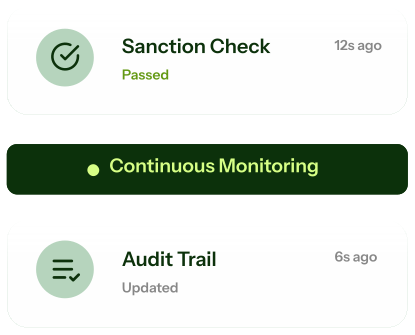
With PaymentWorks, every vendor is screened at onboarding and monitored on an ongoing basis for new sanctions hits, and screening activity is tracked in your account, giving you a record to point to when a review comes up.
Improve 1099 vendor compliance controls
TIN mismatches and missing backup withholding used to be a January problem; now they show up as findings in vendor file audits and financial statement reviews, months before filing season even starts.
Almost every AP team collects W-9s and files 1099s; it’s a large part of vendor compliance management. Far fewer can say with confidence that every TIN was validated before the first payment went out. That gap between “we have a process” and “we have a controlled process” is usually invisible—until January, or until an auditor asks for proof.
Common 1099 vendor compliance gaps include:
- TIN validation that happens after onboarding, or not at all, instead of as part of the intake workflow. Errors surface in January when it’s too late to fix cheaply
- W-9 forms collected but never matched against IRS records, creating backup withholding and penalty exposure
- No process for tracking name/TIN mismatches or B-notices across the vendor lifecycle as vendor details change
- Incomplete audit trails that can’t demonstrate when a TIN was validated, what the result was, or who reviewed a mismatch
Filing accurate 1099s isn’t really the hard part. Proving the underlying vendor data was validated before you relied on it is.
With PaymentWorks, TIN matching happens automatically at onboarding, and changes to that information are tracked in your vendor’s record, so January isn’t a scramble, and you have a history to point to when a mismatch needs to be traced.

Improve supplier due diligence controls
Adding a new supplier used to mean checking a few boxes. Now it means confirming the business is who it claims to be, understanding who actually controls it, and catching risk exposure before it becomes your organization’s problem the moment a payment goes out.
Every procurement or AP team does some form of vendor vetting within vendor compliance management. What’s usually missing is consistency: the scrutiny applied to a six-figure contract rarely gets applied to a smaller one, even though fraud and compliance exposure don’t scale down with the invoice amount.
Common supplier due diligence gaps include:
- Business registration and licensing verified once at onboarding, with no process for re-verification as vendors expand into new jurisdictions
- Beneficial ownership disclosure collected at intake but never validated or refreshed as ownership changes
- No consistent risk-tiering for suppliers, so high-risk vendors get the same light-touch review as low-risk ones
- Incomplete audit trails that can’t demonstrate what due diligence was performed, when, or by whom
Collecting a W-9 and a certificate of insurance isn’t due diligence. Being able to show, for any given vendor, what was actually checked and when is what holds up under scrutiny.
With PaymentWorks, every vendor onboarding and update event runs through identity, tax ID, sanctions, and bank-ownership checks, with a record you can reference later—so when a review comes up, you’re not starting from scratch.

Where does your vendor compliance management stand?
If you’re not sure how strong your vendor compliance management is, schedule a call with one of our specialists.
Book a call