


Back to Case Studies
The University of North Carolina—Asheville: Rethinking Supplier Payments with PaymentWorks EarlyPay
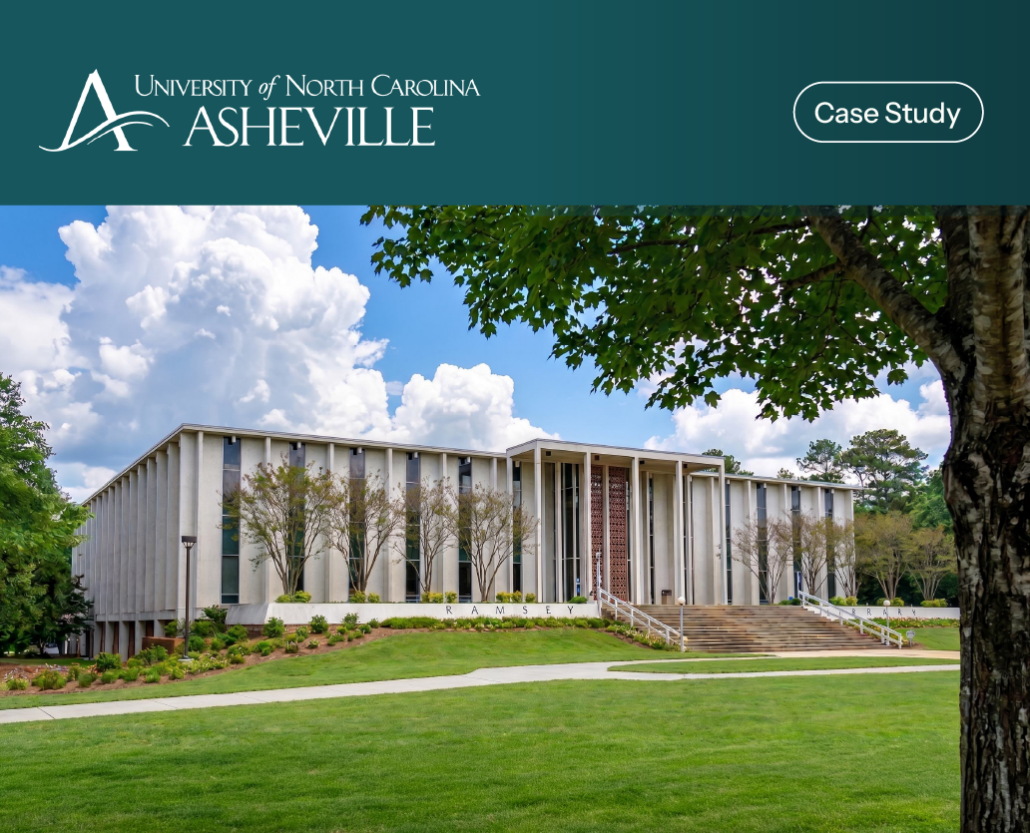

For most accounts payable teams, the job is transactional by definition: invoices come in, approvals happen, checks or ACH payments go out, and the cycle repeats. The University of North Carolina–Asheville wanted something different. As Hunter Fava, the university's Assistant Controller, put it, "I wanted my team's work to be more transformational and not just transactional." That single sentence captures why UNC Asheville's rollout of PaymentWorks EarlyPay is worth a closer look—not just as a university case study, but as a window into what's becoming a broader shift in how organizations think about supplier payments.
The Starting Point
UNC Asheville is a public liberal arts university in Asheville, North Carolina, founded in 1927 and serving roughly 2,900 students. Its accounts payable team, however, operates at a scale that belies the school's size: more than 13,000 active suppliers on file and roughly $110 million in annual AP spend. Managing that volume with legacy tools meant a lot of paper checks, a lot of manual exception-handling, and very little bandwidth for anything beyond keeping the payment engine running.
In December 2024, the university signed with PaymentWorks to modernize that engin, eliminating slow, costly paper check payments in favor of an automated ACH program. The system went live on April 21, 2025, and almost immediately, UNC Asheville activated a second layer on top of it: PaymentWorks EarlyPay.
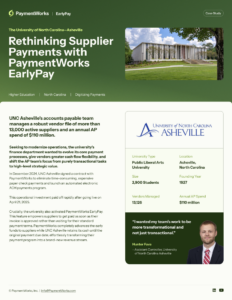
Read the case study here or click the image below.
What "Early Pay" Actually Is
EarlyPay is UNC Asheville's specific implementation of a concept that shows up across the industry under names like supply chain finance, dynamic discounting, or accelerated payment programs. The core idea is simple, even if the mechanics vary by vendor: instead of forcing every supplier to wait the full length of its stated payment terms—net 30, net 45, whatever the contract says—the buying organization gives suppliers the option to get paid faster in exchange for a small, transparent discount.
Two things make this different from a traditional loan or factoring arrangement. First, the buyer isn't the one fronting the cash in every model. With PaymentWorks EarlyPay, PaymentWorks itself advances the funds to the supplier, while the university continues to hold onto its own cash until the invoice's original due date. Second, participation is entirely optional and self-directed. A supplier facing a tight cash cycle—meeting payroll, paying its own subcontractors, covering a seasonal expense—can choose to accelerate a specific payment. A supplier that doesn't need the cash early can simply wait for standard terms and pay no fee at all.
That optionality is what makes these programs a genuine win-win rather than a cost shifted from one party to another. Suppliers get a flexible financing tool that doesn't require opening a line of credit or taking on debt. Buyers, in this case, a university AP department, get a percentage-based commission every time a supplier chooses to accelerate, turning what used to be a pure cost center into a modest but real revenue stream.
How the Pricing Works
The way UNC Asheville's program prices speed is a useful illustration of how these sliding-scale models typically work. Once an invoice is approved, a supplier can choose same-day payment for a 3% fee, payment in 10 days for a 2% fee, payment in 20 days for a 1% fee, or payment in the full 30 days for no fee at all. The fee shrinks the longer the supplier is willing to wait, and if the supplier takes no action and simply lets the invoice run its standard course, no discount applies whatsoever. It's worth underscoring that last point, because it's often misunderstood: an early pay program doesn't penalize suppliers who don't participate. It only ever creates an upside for the ones who choose to use it.
This structure is also why EarlyPay slotted in next to UNC Asheville's existing payment rails (direct deposit, wire transfer, and even paper check) rather than replacing them. Suppliers see it as one more option in their payee profile, alongside the payment methods they're already used to, which lowers the barrier to adoption considerably.
Why UNC Asheville Said Yes
The university's finance team pointed to three specific reasons EarlyPay made sense. First, it required essentially zero direct AP workload: PaymentWorks handled configuration, vendor outreach, and ongoing enrollment support in the background, so a lean AP staff never had to actively manage or promote the program. Second, it didn't cannibalize the university's existing virtual card progra. The two coexist, and UNC Asheville retained 100% of its virtual card spend even after EarlyPay launched. Third, and perhaps most notably, it created a new, essentially risk-free revenue stream, since the university only earns a commission when a supplier actively chooses to accelerate a payment. There's no cost or exposure on payments that run their normal course.
That last point matters for any organization sizing up whether a program like this is worth the effort. Because the fee is supplier-initiated and supplier-funded, the buying organization isn't taking on new financial risk to offer it but rather monetizing a choice suppliers were already going to make one way or another (waiting, or asking for accelerated payment through some messier, off-platform channel).
Fast Implementation, Faster Payoff
Because the underlying workflow data was already native to the PaymentWorks environment UNC Asheville had just deployed, turning on EarlyPay required almost no additional manual effort. The university essentially flipped a switch and let the system manage vendor outreach on its own. That quick time-to-value shows up clearly in the results: within the first year, 30% of UNC Asheville's vendor base—283 suppliers—enrolled in EarlyPay, and cumulative advance volume climbed steadily from roughly zero in mid-2025 to nearly $2 million by March 2026.
The Bigger Picture
What's most instructive about UNC Asheville's experience is the pattern behind the numbers—one that applies well beyond higher education. Historically, when a supplier needed cash faster than standard terms allowed, the result was manual, ad hoc, and friction-heavy: phone calls, emails, one-off exceptions pushed through the AP queue by hand. Early pay programs replace that noise with a structured, self-service option that suppliers control themselves, which simultaneously reduces administrative burden on the buyer's team and strengthens the underlying vendor relationship. Suppliers get real financial flexibility without taking on debt; buyers get a new revenue line without new risk; and the AP function itself shifts from a purely tactical, transaction-processing role into something closer to a strategic lever for working capital and vendor management.
For any organization managing a large, recurring supplier base—a university, a municipality, a hospital system, a corporation—the underlying question UNC Asheville answered is the same one worth asking: is your payment program just moving money, or could it also be creating value? As Fava summed it up, watching the program continue to grow and "generate more cashflow for us," the answer, once the infrastructure is in place, tends to answer itself.
How Vendor Management Appreciation Day Can Help
All this talk about how to improve vendor management processes has us revved up for the ultimate vendor management holiday: Vendor Management Appreciation Day (VMAD)!
What it is: It’s a way for everyone to come together in honor of one of the most important, sometimes under-recognized roles across industries: vendor management. In other words, it’s a big reason to celebrate!
What we’re doing: We’re offering a slew of gifts and an impressive calendar of events.
How to participate: Join the party and keep an eye on your inbox for reminders about new gifts and new things to add to your calendar.

VMAD is a brand-new holiday geared toward unifying vendor management professionals and celebrating innovation in the field.
We’ve been releasing gifts each month to help you supercharge your vendor management efforts. We’re also planning some awesome events so everyone can connect and celebrate the important, strategic role of vendor management.
Learn more here, and grab some free vendor management goodies.
Want Help Aligning Your Teams to Earn Revenue on AP?
Explore our blogs below. They’re filled with action items you can implement right away.
A Vendor Management Template You’ll Actually Use
Who Cares About Vendor Management? The Treasury Function We Don’t Discuss
Tackling Accounts Payable Challenges: Effective Solutions
Vendor Management Tips From the Experts Themselves
Vendor Verification: How NOT to Do it and What to Do Instead
Interested In Regular Tips to Earn Revenue on AP?
Want Personalized Guidance on How to Earn Revenue on AP?

Let us show you how we can help
We’d love to walk through your process with you and talk about security, compliance, efficiency and sleeping better at night.
See How it Works