



Back to Case Studies
University of North Texas: Earning Revenue on AP with PaymentWorks EarlyPay

From BEC attack to vendor verification mandate: how UNT protects supplier spend
In 2021, the University of North Texas was hit by a business email compromise scheme targeting supplier payments. It was the kind of incident that exposes exactly where a decentralized process breaks down — and for UNT, it became the reason the university started looking for a third-party service that could take on vendor verification risk directly, rather than just flag it.
UNT is a big operation to protect. As the third-largest university in Texas and the 24th-largest in the country, its centralized purchasing and accounts payable functions — combined since 2012 across three main campuses — manage 18,600 active suppliers and $400 million in annual AP spend, running on PeopleSoft Financials and Jaggaer. That scale is exactly what made the 2021 fraud attempt so dangerous, and exactly what made manual vendor verification unsustainable going forward.
Read the case study here or click the image below.
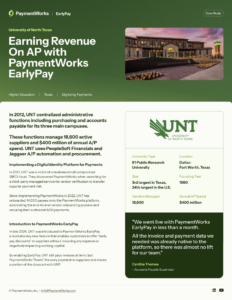
A Fraud Incident Led UNT to PaymentWorks — Then to a New Way to Pay
UNT implemented PaymentWorks in 2022, onboarding 14,000 payees and automating vendor onboarding end to end, with outbound ACH payments secured against exactly the kind of fraud that had targeted the university the year before. That was the starting point. What UNT didn't expect was that the same platform would eventually turn its AP department into a revenue generator.
In late 2024, UNT was introduced to PaymentWorks EarlyPay — a feature that lets organizations offer early-payment discounts to suppliers without spending anything or touching their own working capital. Here's the mechanism: UNT continues to pay invoices at standard term, exactly as it always has. PaymentWorks floats the early payment to the supplier out of its own funds, then shares a portion of the resulting discount with UNT. The university isn't financing anything early — PaymentWorks is, and UNT gets paid for making the option available.
For suppliers, the pricing is a diminishing sliding scale tied to how much sooner they get paid: 3% off if they're paid the same day the invoice is approved, 2% at 10 days, 1% at 20 days, and no fee at all if they simply wait for UNT's standard 30-day term. Nobody is charged for taking the timeline they already had. The fee only applies to the days a supplier chooses to skip.
Minimal Lift, Voluntary Adoption, New Revenue — the Case Made Itself
UNT's decision came down to three things. First, EarlyPay required minimal technical effort to configure and added no ongoing workload for AP staff — because the invoice and payment data it needs was already native to the PaymentWorks platform UNT was running. Second, adoption is entirely supplier-driven: vendors choose EarlyPay for themselves during standard onboarding, rather than AP staff having to sell or manage the option. Third, every dollar advanced through the program generates a percentage-based commission for the university — a revenue stream that didn't exist before and that costs UNT nothing to operate.
That third point is what separates EarlyPay from a typical early-payment or dynamic-discounting tool. Most versions of this idea ask the buyer to either put up the capital or accept a hit to working capital in exchange for supplier goodwill. UNT does neither. It keeps paying on its own schedule and collects a commission on funds it never advanced.
Implementation reflected the same low-friction design. UNT went live with EarlyPay in less than a month. As Cynthia Thomas, UNT's Accounts Payable Supervisor, put it: "All the invoice and payment data we needed was already native to the platform, so there was almost no lift for our team." The team simply configured the existing supplier registration form to include the EarlyPay option and ran routine testing before pushing it to production — no new integration, no new data source, no new process for AP to maintain.
1,200 Vendors, $1.8 Million a Month, and Counting
The adoption curve tells its own story. Three hundred UNT vendors had enrolled in EarlyPay by the program's early months, advancing roughly $200,000 a month. That grew to 900 vendors and $600,000 a month, then 1,100 vendors and $1.15 million. Within the first 14 months, enrollment passed 1,200 vendors, with monthly payment advances climbing past $1.8 million — a nine-fold increase in volume in just over a year, driven entirely by suppliers opting in on their own.
"In just over a year, more than 1,200 of our vendors enrolled in EarlyPay," said Beth Acevedo, UNT's Director of Procurement. "That kind of demand told us suppliers really do value getting paid faster." That demand is the whole point: EarlyPay doesn't ask UNT to guess at what its vendors want. It gives vendors the choice and lets the enrollment numbers answer the question.
The commission UNT earns on that volume is now on track to cover the university's annual PaymentWorks subscription fee outright. That reframes the platform's economics entirely. UNT isn't just running a more secure, more automated vendor onboarding process than it had before its 2021 fraud incident — it's on a path to running that process, plus a supplier payment security program, at no net cost to the university.
A Security Fix That Became a Revenue Line
UNT went looking for a way to close a fraud gap and ended up with a program that pays for itself. That's the throughline: a platform adopted to secure outbound payments after a business email compromise incident is now generating enough commission revenue to offset its own cost, while giving 1,200-plus suppliers a payment option they chose for themselves. For a university managing $400 million in annual AP spend across three campuses, that's not a minor efficiency gain — it's a vendor payment program that protects the institution and pays it back at the same time.
PaymentWorks EarlyPay is available today to any PaymentWorks customer already running vendor onboarding through the platform, with no additional integration required.
How Vendor Management Appreciation Day Can Help
All this talk about how to improve vendor management processes has us revved up for the ultimate vendor management holiday: Vendor Management Appreciation Day (VMAD)!
What it is: It’s a way for everyone to come together in honor of one of the most important, sometimes under-recognized roles across industries: vendor management. In other words, it’s a big reason to celebrate!
What we’re doing: We’re offering a slew of gifts and an impressive calendar of events.
How to participate: Join the party and keep an eye on your inbox for reminders about new gifts and new things to add to your calendar.

VMAD is a brand-new holiday geared toward unifying vendor management professionals and celebrating innovation in the field.
We’ve been releasing gifts each month to help you supercharge your vendor management efforts. We’re also planning some awesome events so everyone can connect and celebrate the important, strategic role of vendor management.
Learn more here, and grab some free vendor management goodies.
Want Help Aligning Your Teams to Earn Revenue on AP?
Explore our blogs below. They’re filled with action items you can implement right away.
A Vendor Management Template You’ll Actually Use
Who Cares About Vendor Management? The Treasury Function We Don’t Discuss
Tackling Accounts Payable Challenges: Effective Solutions
Vendor Management Tips From the Experts Themselves
Vendor Verification: How NOT to Do it and What to Do Instead
Interested In Regular Tips to Earn Revenue on AP?
Want Personalized Guidance on How to Earn Revenue on AP?
Let us show you how we can help
We’d love to walk through your process with you and talk about security, compliance, efficiency and sleeping better at night.
See How it Works